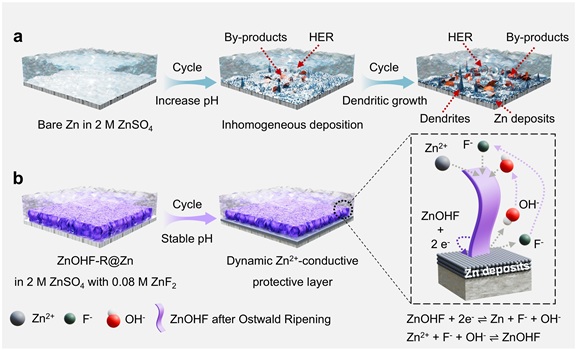
The Zn anode in aqueous zinc-ion batteries (AZIBs) suffers from hydrogen evolution reaction (HER), by-product accumulation, and dendrite growth, severely restricting practical viability. To address these challenges concurrently, we propose a dynamic Zn2+-conductive protective layer strategy, which involves constructing an in situ ZnOHF layer on the Zn anode and incorporating F- into the electrolyte. Zn2+-conductivity and reducibility of ZnOHF layer guide uniform Zn nucleation and deposition, thereby inhibiting dendrite formation. Crucially, the addition of F- to the electrolyte enables the dynamic regeneration of the ZnOHF layer during cycling and the conversion of detrimental by-products into favorable ZnOHF. Additionally, HER is effectively suppressed by isolating the Zn anode from the aqueous electrolyte via ZnOHF interfacial layer, and decreasing water activity through F- induced elevation of electrolyte pH from 4.1 to 5. As a result, the protected Zn anode enables the symmetrical cell to operate stably for 3100 h at 0.5 mA cm−2, and a full cell to retain 85% capacity after 4000 cycles at 10 A g−1. Moreover, a 90 cm2 pouch cell delivers an initial capacity of 240 mAh and maintains 70% capacity after 200 cycles, highlighting its practical viability. This work presents an effective and scalable interface engineering approach to realize durable Zn anodes for practical AZIBs.
The article links:https://doi.org/10.1002/adma.73449