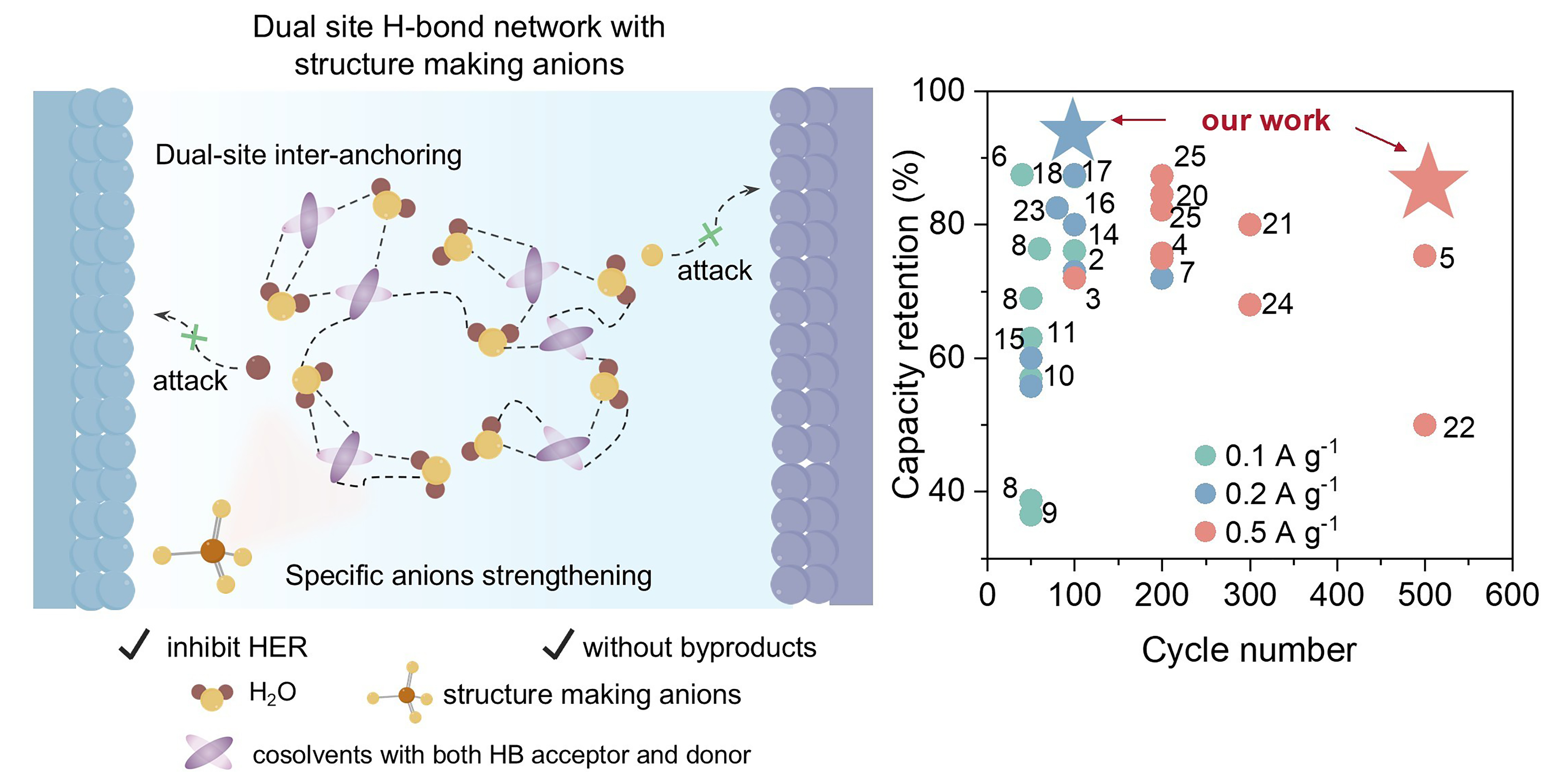
Aqueous zinc-ion batteries (ZIBs), known for their intrinsic safety, low cost, and high ionic conductivity, have emerged as promising candidates for large-scale energy storage systems. Among the commonly used cathode materials, vanadium-based cathodes stand out due to their high capacity, simple energy-storage mechanism, and good compatibility with high mass loading. However, the strong reactivity of water molecules in the electrolyte leads to severe vanadium dissolution at the cathode, hydrogen evolution, and Zinc (Zn) corrosion at the anode, which hinders the long-lasting cycling performance of ZIBs, especially at low current density.
In a recent study published in Angewandte Chemie International Edition, our group constructed a robust hydrogen-bond network within the electrolyte, minimizing the reactivity of both hydrogen (H) and oxygen (O) atoms in water. This design suppresses deterioration on the bilateral electrode.
To build this robust H-bond network, the researchers employed ethylene glycol as a cosolvent and sulfate ion (SO42-) as structure-making anions. Owing to its abundant H-bond acceptors and donors, ethylene glycol provides a dual-site H-bond anchoring effect on active water molecules, thus effectively impeding the incursion of both H and O atoms towards both electrodes. Notably, the ion-specific, structure-making capability of SO42- further strengthens this dual-site anchoring, reducing vanadium dissolution at the cathode.
Moreover, ethylene glycol-induced modulation of Zn2+ solvation structures accelerates Zn2+ desolvation kinetics at the cathode and enhances the (de)intercalation reversibility of both Zn2+ and H+. Benefitting from these synergistic effects, ZIBs using the ethylene glycol-containing electrolyte achieve long-lasting cycling stability, retaining 87% capacity retention after 500 cycles at 0.5 A g-1.
Furthermore, the optimized electrolyte enabled a 90 cm2 pouch cell to deliver a high capacity of 2 Ah at 4 A, while retaining 80% capacity after 70 cycles, underscoring its strong practical potential.
The article links:https://onlinelibrary.wiley.com/doi/10.1002/anie.202519611