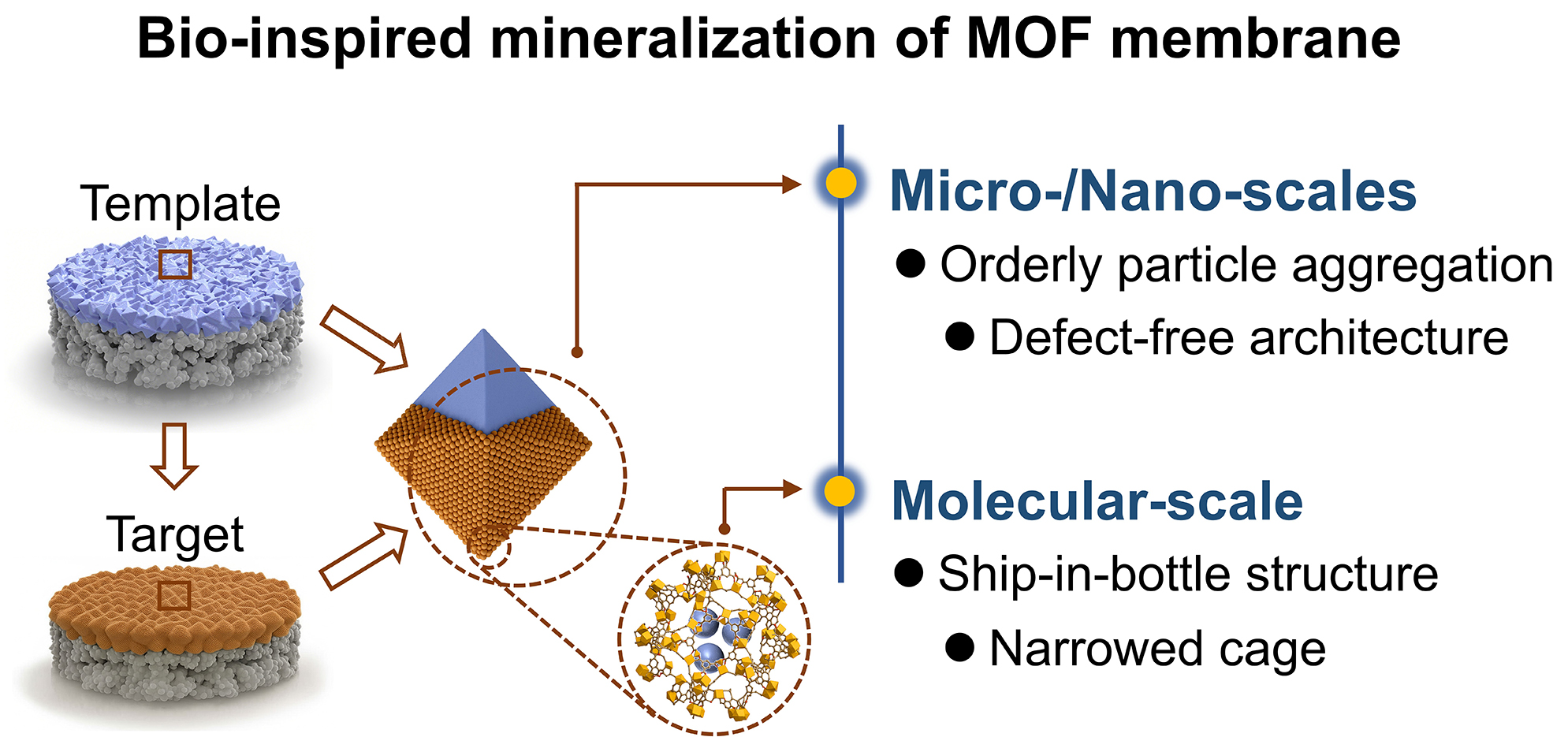
Azeotropic dehydration is a crucial separation process in chemical manufacturing, pharmaceutical production, and biomass refining. Conventional distillation is highly energy-intensive because it is constrained by vapor–liquid equilibrium limitations. Membrane-based pervaporation offers a more energy-efficient alternative; however, simultaneously achieving membrane structural integrity and precise molecular sieving remains a longstanding challenge. Inspired by natural biomineralization processes, our group developed a biomineralization-inspired mineralization (BIM) strategy to synergistically engineer MOF membranes across micro-, nano-, and molecular scales. In this work, a readily accessible CuBTC membrane was employed as a structured template and transformed in situ into an MIL-100 membrane through Fe3+ substitution. During the transformation process, the template surface acted as an anchored nucleation platform that directed the point-by-point assembly of MIL-100 nanocrystals, resulting in a dense and defect-free membrane architecture. Meanwhile, a dynamic competition between template “sacrifice” and preservation generated a unique hierarchical “ship-in-bottle” structure, where encapsulated CuBTC nanoclusters effectively narrowed the MIL-100 mesocages to molecular dimensions, thereby enabling precise discrimination between water and organic molecules. The resulting MIL-100 membrane demonstrated outstanding dehydration performance for various aqueous azeotropes. For a 90 wt% ethanol/water feed, the membrane achieved an ultrahigh separation factor of 3200 with a total flux of 2.58 kg m-2 h-1, significantly surpassing most state-of-the-art MOF membranes. In addition, the membrane exhibited excellent long-term operational stability and adaptability toward complex feed systems. This work provides a new bioinspired route for the rational design of high-performance crystalline porous membranes for energy-efficient molecular separations.
The article links:https://doi.org/10.1021/jacs.5c21467