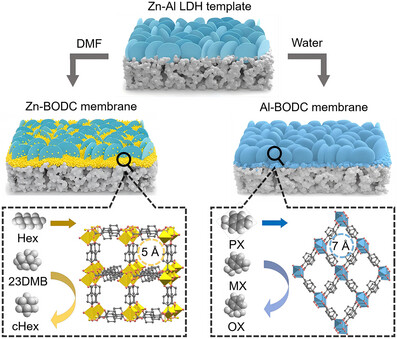
Efficient separation of structurally similar isomers is a longstanding challenge in petroleum refining and fine chemical manufacturing. Because these molecules possess nearly identical molecular sizes and physicochemical properties, conventional distillation processes are highly energy-intensive. Molecular-sieving MOF membranes offer a promising low-energy alternative; however, precise control over membrane growth pathways and defect formation remains difficult. To address this challenge, the research team developed a vertically aligned Zn-Al layered double hydroxide (LDH) nanoarray serving simultaneously as a template and metal source. By switching the synthesis solvent between N,N-dimethylformamide (DMF) and water, two distinct membrane growth routes were successfully directed. In the DMF system, the LDH framework remained stable and promoted interface-confined interstitial growth, producing a dense Zn-BODC membrane with ~0.5 nm apertures for efficient n-hexane/2,3-dimethylbutane separation. In contrast, the aqueous system triggered rapid template dissolution and reconstruction, generating a honeycomb-like Al-BODC membrane with ~0.7 nm pores capable of highly selective para-/ortho-xylene separation. Mechanistic studies further revealed that the separation behavior of both membranes is predominantly governed by configurational entropy effects rather than diffusion enthalpy barriers. Differences in molecular flexibility and entropy loss under confinement dictate the selective transport behavior. This work establishes a new framework for solvent-directed MOF membrane growth and provides a versatile strategy for designing ultramicroporous membranes for challenging isomer separations..
The article links:https://doi.org/10.1002/anie.4011249