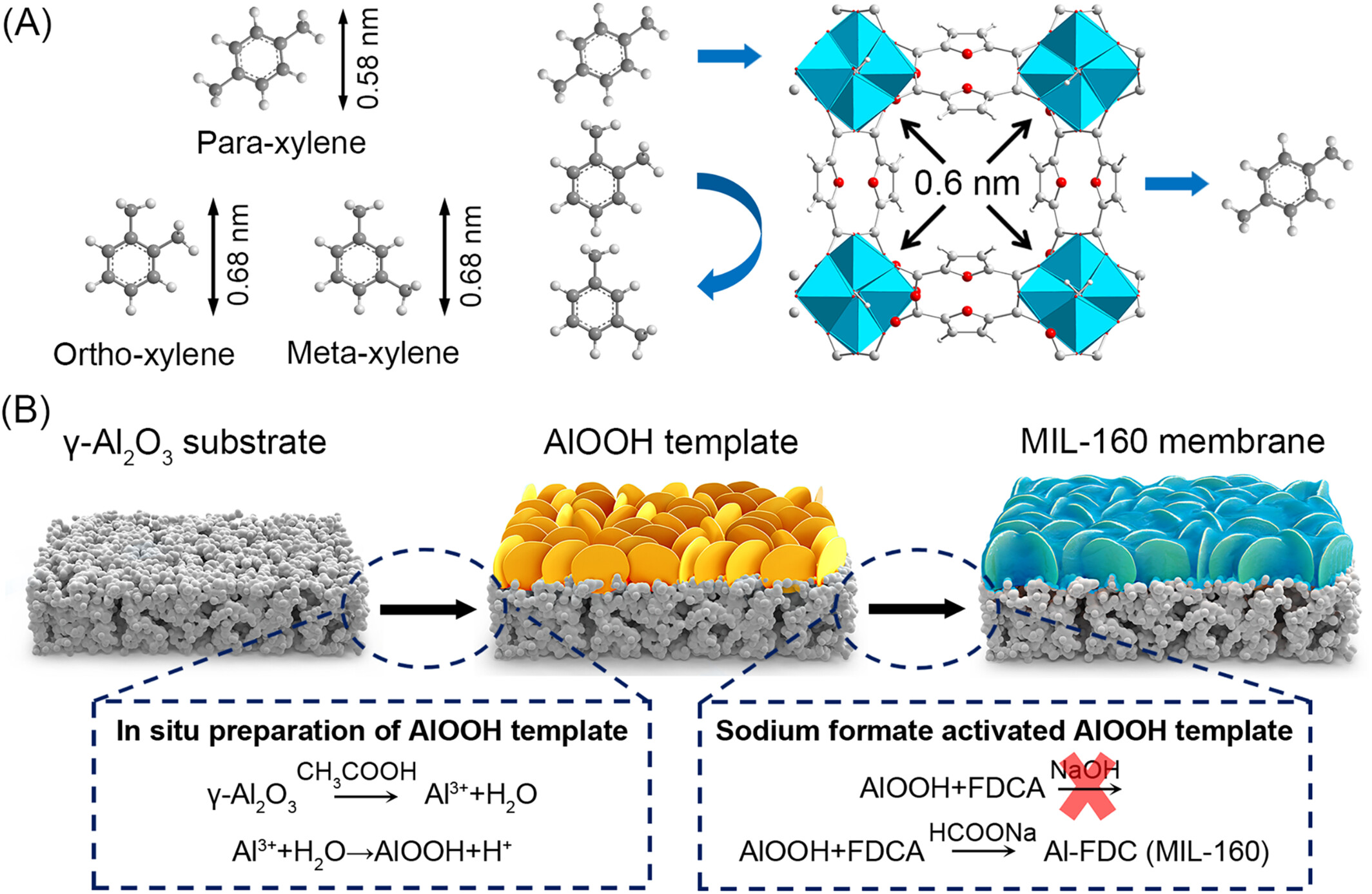
Para-xylene (PX) is an essential feedstock for the production of terephthalic acid and other high-value aromatic chemicals. However, the separation of PX from its isomers, especially ortho-xylene (OX), remains highly challenging because of their nearly identical molecular dimensions and physicochemical properties. Conventional distillation processes are extremely energy-intensive, making membrane-based separation an attractive low-energy alternative. Nevertheless, the fabrication of high-performance MOF membranes is often hindered by poor heterogeneous nucleation, uncontrolled crystal growth, and unavoidable grain-boundary defects. To address these challenges, our group developed a vertically aligned AlOOH nanoflake array as a structured template for MIL-160 membrane growth and introduced sodium formate to regulate the nucleation process. It was found that formate ions preferentially coordinated with aluminum nodes on the AlOOH surface, weakening intrinsic Al–O bonds and facilitating the insertion of the 2,5-furandicarboxylate linker, which was critical for initiating efficient heterogeneous nucleation. Meanwhile, the nanoflake template guided crystal growth along the substrate surface and promoted seamless boundary fusion, ultimately yielding polymer-like crystalline membranes with highly integrated microstructures. The resulting MIL-160 membrane demonstrated outstanding xylene isomer separation performance. For an equimolar PX/OX mixture, the membrane achieved a PX permeance of 4.42 × 10⁻⁷ mol m-2 s-1 Pa-1 and a PX/OX selectivity of 24.2. Furthermore, a two-stage membrane process enriched PX concentration from 20 wt% in the feed to 98 wt% in the permeate, providing a viable route for producing high-purity aromatic feedstocks. This work offers a scalable strategy for constructing high-performance MOF membranes for energy-efficient aromatic isomer separations.
The article links:https://doi.org/10.1002/aic.70156